Table of Contents
- What Makes a High Quality Swim Hat for Women?
- Best Sun Protection Hats for Swimming: UPF and Coverage
- Swim Caps for Long Hair: Preventing Breakage and Snags
- Comfort and Durability: Non-Slip, Anti-Tear, and Chlorine Resistance
- Eco-Friendly and Hypoallergenic Swim Hat Options
- How to Care for Your Swim Hat: Maintenance and Quick-Dry Tips
- Conclusion
- Frequently Asked Questions
Last Updated: September 27, 2026
What Makes a High Quality Swim Hat for Women?
A high quality swim hat for women is a snug, non-slip cap that protects hair from chlorine and sun while staying put through laps, and it comes down to three things: material, fit, and how well it resists wear. We've watched swimmers along the South Bay coastline wrestle with caps that ride up mid-lap or snag every strand on the way off. Below, we'll break down what separates a cap you'll wear for years from one that ends up at the bottom of a beach bag by June.
The first thing most shoppers get wrong is assuming all swim hats are interchangeable. They're not.
Material Matters: Silicone, Latex, and Fabric
Silicone is the most durable option. It's thicker, holds its elasticity longer, and resists chlorine better than latex. The trade-off is a tighter initial feel and a higher price point. Latex stretches more easily and costs less, but it tears faster and can irritate sensitive skin. Fabric caps, sometimes called turban style, prioritize comfort and hair protection over hydrodynamic performance.
For recreational swimming and sun exposure, silicone and fabric caps cover most needs. Competitive swimmers tend toward silicone for the secure fit it holds lap after lap.
Fit and Sizing for Different Head Shapes
Fit is where most swim hats fail. A cap that's too small causes headaches and hair breakage; too large and it slides up mid-stroke.
Measure your head circumference with a soft tape just above the ears, then match it to the cap's size chart. Rounder head shapes often need a deeper cap, while longer shapes benefit from extra crown room. Adjustable chin straps help with a secure fit across shapes.
| Material | Best For | Durability | Hair Protection |
|---|---|---|---|
| Silicone | Daily lap swimming | High | Moderate |
| Latex | Budget, casual use | Low | Moderate |
| Fabric/Turban | Long, curly hair | Moderate | High |
Best Sun Protection Hats for Swimming: UPF and Coverage
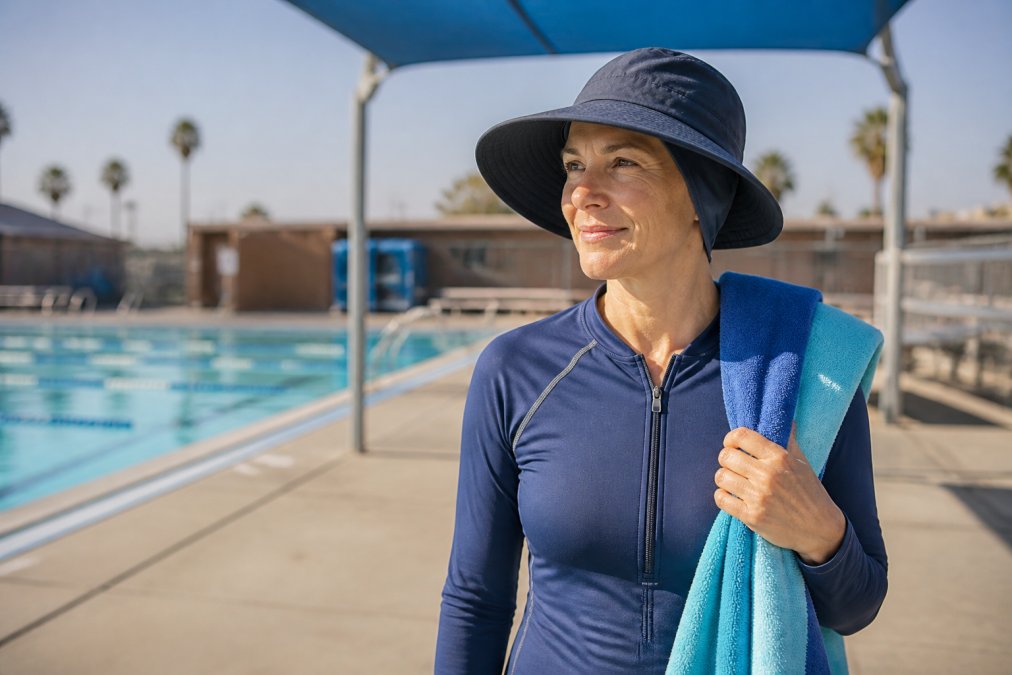
The best sun protection hats for swimming pair a tested UPF rating with coverage that survives a lap. UPF, or Ultraviolet Protection Factor, is a fabric rating, not a sunscreen rating. It measures how much UV radiation passes through the material. A UPF 50 rating blocks roughly 98% of UV rays, per the Skin Cancer Foundation's sun protection guidance. UPF 15 blocks about 93%, UPF 30 about 97%, and UPF 50+ is the top tier most testing labs assign.
Here's the part most guides skip: UPF is measured on dry fabric under tension.
What Coverage Actually Protects
UV exposure on the head clusters in four zones, and each needs a different solution:
- Scalp and part line, the highest-risk area for women, because hair provides uneven coverage. A snug cap covers it; a brim does not.
- Ears, a legionnaire-style flap or an ear-covering cap handles this. Standard caps leave ears exposed.
- Neck and jawline, a wide brim (3 inches or more) or a neck flap. Brims work when you're upright, not when you're horizontal in the water.
- Face and nose, brim only. No swim cap covers the face.
Reading a UPF Label Without Getting Fooled
A few practical checks before you buy:
- Look for a number, not a word. "Sun protective" and "UV blocking" are marketing terms. UPF 50+ is a tested claim.
- Check whether the rating is for wet or dry fabric. Some manufacturers test both and publish the wet rating; most don't. When in doubt, assume the wet rating is lower.
- Darker, denser weaves generally rate higher than light, open knits at the same thickness.
- Stretch matters. A cap that fits snugly without over-stretching holds its rating better than one pulled tight across a larger head.
Swim Caps for Long Hair: Preventing Breakage and Snags
Swim caps for long hair need extra crown room and a low-friction interior. A standard cap sized for a bare head will pull, snap strands, and ride up the moment you push off the wall. The fix is matching cap volume to hair volume, not just head circumference.
Match Cap Volume to Hair Volume
Most sizing charts list head circumference only. That works for short hair and fails for long hair, because a bun or ponytail adds real volume at the crown and back of the head. A practical rule:
- Shoulder-length or shorter, worn loose: standard cap size is usually fine.
- Shoulder-length or longer, worn in a bun: size up one step, or choose a cap explicitly labeled for long hair or XL.
- Thick, curly, or textured hair: size up one step even at shorter lengths, because density adds bulk that a standard cap compresses painfully.
- Locs, braids, or twists: look for a cap marketed for braids or a turban-style fabric cap, which has the most interior room.
The Application Sequence That Prevents Breakage
Technique matters as much as the cap. The sequence below is what most long-haired swimmers settle into after trial and error:
- Wet your hair thoroughly with fresh water before you get in the pool. Saturated hair absorbs less chlorine.
- Add a light leave-in conditioner or a small amount of coconut oil to the lengths and ends. This is the friction barrier.
- Gather hair low, at the nape, not on top of the head. A high bun pushes the cap up and creates a pressure point.
- Twist into a loose bun or coil and secure with a soft, snag-free tie, no metal, no rough elastic.
- Stretch the cap wide with both hands, front to back, and seat the front edge at your forehead first.
- Roll the back down over the bun rather than pulling it down from the top. Pulling from the top is what snaps strands.
- Tuck stray hairs at the hairline with a wet finger, not by yanking the cap edge.
Why Satin Linings Help
Curly and textured hair needs the same care plus a satin-lined cap if you can find one. The lining cuts down on the friction that causes frizz and split ends, and it makes the cap easier to remove without disturbing curl clumps.
Comfort and Durability: Non-Slip, Anti-Tear, and Chlorine Resistance
For swimmers prone to swimmer's ear, a snug cap that covers the ears adds a layer of protection alongside earplugs.
Eco-Friendly and Hypoallergenic Swim Hat Options
Eco-friendly swim hats use recycled silicone or natural rubber, and hypoallergenic options skip the latex proteins that trigger reactions. Latex allergies are common, and the symptoms, ranging from itching to a rash, are worth taking seriously. The American College of Allergy, Asthma & Immunology notes that latex sensitivity can develop with repeated exposure, which is why many swimmers switch to silicone over time.
How to Care for Your Swim Hat: Maintenance and Quick-Dry Tips
Proper care keeps a swim hat in shape for years instead of months. The routine is simple and takes under a minute.
- Rinse in cool fresh water immediately after each swim
- Gently pat dry with a towel, never wring or twist
- Lay flat or hang to air dry away from direct sun
- Dust lightly with talc or cornstarch if silicone feels tacky
- Store loosely, not folded or stretched
Conclusion
Finding swim hats that hold up through a full season of sun, salt, and chlorine takes a little know-how, but the payoff is gear that lasts. South Bay Gear has been a part of the South Bay community since 1960, and our hats, caps, and visors are designed for this coastal life. Browse our California beach wear for simple, classic pieces made to handle the water and the sun, with free shipping on select items.
Frequently Asked Questions
What is the best swim cap for women?
The best swim cap depends on your hair type and swimming routine. Silicone caps offer durability and a snug fit for competitive swimming, while latex caps are thinner and easier to put on for recreational use. For long or curly hair, look for a turban-style or extra-large silicone cap that accommodates volume without pulling. Prioritize a non-slip interior and UV protection if you swim outdoors.
Is there a swim cap that actually keeps your hair dry?
No swim cap keeps hair completely dry, but a well-fitted silicone or latex cap reduces water exposure significantly. Water seeps in around the hairline, especially during extended swims. To minimize wetness, choose a snug fit, avoid trapping air bubbles, and consider a lycra cap underneath a silicone one for extra protection. For maximum dryness, focus on caps with a wide edge that seals against the forehead.
What are the best hats to wear while swimming?
For open-water or pool swimming, silicone and latex swim caps are the standard. If you need sun protection, look for swim hats with a wide brim or legionnaire style made from quick-dry, UPF 50+ fabric. These hats shield your face and neck while staying secure in the water. For casual beach swimming, a snug-fitting bucket hat with a chin strap works well.
How do I choose a swim hat with UV protection?
Check the UPF rating: UPF 50+ blocks 98% of UV rays. Look for hats with a wide brim or neck flap for full coverage, and choose quick-dry, breathable fabrics like nylon or polyester. A snug fit with an adjustable chin strap keeps the hat in place during swimming. For pool use, ensure the material is chlorine-resistant to maintain protection over time.
0 comments