Table of Contents
- What Defines Coastal Lifestyle Clothing for Active Adults
- Breathable Summer Fabrics That Handle Salt, Sweat, and Sun
- UPF Sun Protective Clothing: What the Ratings Actually Mean
- Coastal Vacation Outfits That Work From Beach to Boardwalk
- Building a Capsule Wardrobe for an Active Coastal Life
- Care and Maintenance for Performance Coastal Clothing
- Environmental Impact Beyond Recycled Polyester
- Conclusion
- Frequently Asked Questions
Last Updated: September 19, 2026
What Defines Coastal Lifestyle Clothing for Active Adults
Coastal lifestyle clothing for active adults is apparel built for movement between water, sand, and town without changing outfits, breathable fabrics, quick-dry construction, and sun protection in a relaxed look that works at the beach and on the boardwalk.
Breathable Summer Fabrics That Handle Salt, Sweat, and Sun
The best breathable summer fabrics for coastal wear are combed and ring-spun cotton for dry conditions, and technical synthetics or cotton-synthetic blends for water-adjacent activity. The right pick depends on how wet you get.
A practical split for most active adults:
- Dry-land days: lightweight cotton tees and woven shorts
- Water days: quick-dry swimwear and synthetic tops
- Transition days: a cotton tee over a quick-dry base layer
What the Fabric Labels Actually Tell You
Most shoppers read fiber content and stop there. Construction details matter just as much:
- Fabric weight (GSM): A lightweight tee in the 140-160 GSM range breathes and layers well; 180-220 GSM holds shape longer but dries slower.
- Knit structure: Jersey knit is standard. Waffle, mesh, and birdseye knits add airflow channels that move heat away from skin.
- Wicking finish: A treatment that pulls sweat to the fabric surface so it evaporates faster. It washes out over time, which is why technical gear loses performance after a couple of seasons.
- Dry time: A quick-dry synthetic tee typically air-dries in under an hour in sun and breeze; a comparable cotton tee can take three to four times as long.
Why Salt Is the Real Test
Salt exposure is the detail people overlook. Salt crystals left in fabric act like tiny abrasives, they stiffen cotton, dull color, and accelerate fiber breakdown. Synthetics tolerate salt better but still benefit from a rinse.
Fit and Body Type Matter More Than Fiber
Most coastal clothing guides treat every body the same, but the same fabric performs differently depending on cut:
- Broader shoulders or chest: Raglan sleeves or a drop-shoulder cut let fabric drape instead of pulling tight across the chest, where UPF ratings and breathability degrade fastest.
- Longer torsos: A standard crew tee rides up when you reach or paddle. Look for a longer body length or a curved hem that stays put.
- Petite frames: Oversized coastal tees can swallow the frame and bunch at the waist. A retail or slim fit with a slightly shorter body length reads relaxed without looking borrowed.
- Mid-size and plus: Prioritize fabrics with mechanical stretch (a small percentage of elastane or a ribbed knit) so the garment moves with you instead of clinging after a swim.
UPF Sun Protective Clothing: What the Ratings Actually Mean
UPF sun protective clothing is rated on a scale measuring how much ultraviolet radiation the fabric blocks. UPF 50 means roughly 1/50th of UV radiation passes through, blocking about 98%.
| UPF Rating | UV Blocked | Protection Level |
|---|---|---|
| UPF 15-24 | ~93-96% | Good |
| UPF 25-39 | ~96-97% | Very good |
| UPF 40-49 | ~97.5% | Excellent |
| UPF 50+ | ~98%+ | Maximum |
Coastal Vacation Outfits That Work From Beach to Boardwalk
The outfit that survives a full coastal day is built in layers: a quick-dry base, a breathable cotton or performance tee, and something you can shed or add as the sun moves.
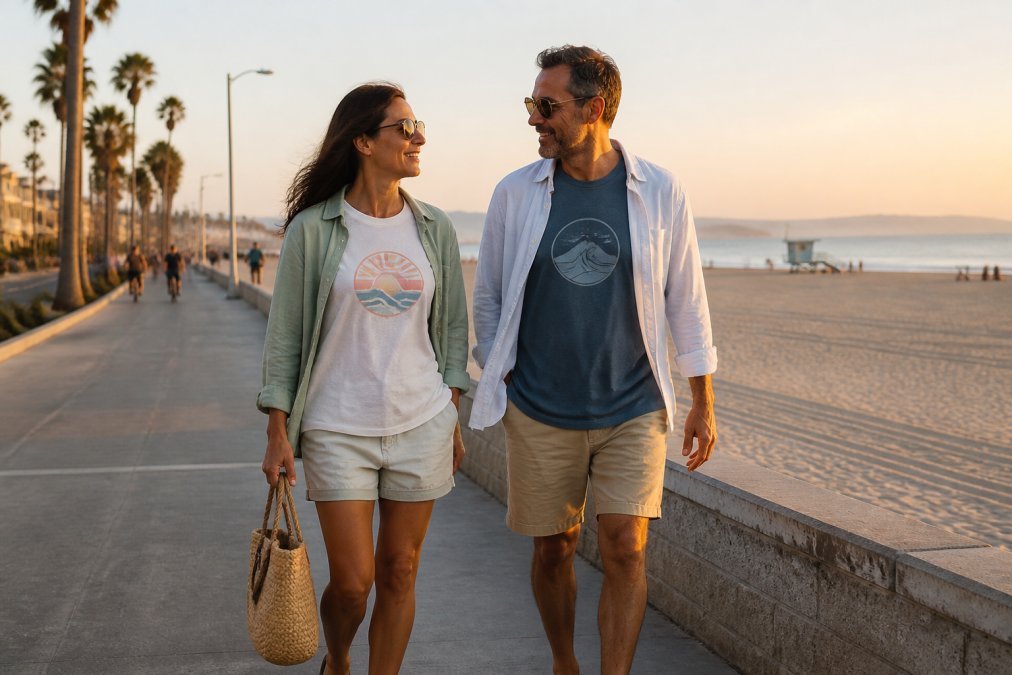
- Base layer: quick-dry swim or synthetic tee
- Mid layer: a graphic cotton tee like the Hermosa Beach Tee or the Huntington Beach Retro Logo T-Shirt, both lightweight ring-spun cotton that layers without bulk
- Sun layer: a UPF-rated long sleeve or a wide-brim hat
- Footwear: sandals for sand, closed shoes for the walk back
- One bag: something that holds a towel, a layer, and water
Building a Capsule Wardrobe for an Active Coastal Life
A coastal capsule wardrobe is a small set of pieces that all work together, all handle salt and sun, and all fit the same relaxed register. The real test isn't how many items you own, it's how few you can pack for a week and still cover every scenario.


The Core Framework
The framework that works: pick four categories, cap each at a handful of items, and require every piece to work with every other piece.
| Category | Suggested Count | What to Prioritize |
|---|---|---|
| Tops | 5-7 | Breathable cotton and quick-dry tees |
| Bottoms | 3-4 | Swim, woven shorts, one relaxed pant |
| Layers | 2 | UPF long sleeve, light hoodie or overshirt |
| Accessories | 3 | Hat, sunglasses, one tote |
The 7-Piece Coastal Travel Checklist
Here's the angle most guides skip: how to pack for a week-long coastal trip using only 5-7 versatile pieces.
Hermosa Beach Tee — Colorful Front/Back →
The 7 pieces:
- One quick-dry swim top or rash guard, doubles as a base layer under a tee
- One quick-dry swim bottom or board short, works as a swim trunk and a casual short
- Two lightweight cotton tees, one graphic, one solid; layer over the swim base
- One UPF long-sleeve sun shirt, your sun layer for paddle days and long walks
- One relaxed woven short, the town-and-dinner bottom
- One light overshirt or hoodie, the evening layer for cool coastal air
- One wide-brim hat, sun protection that also finishes the outfit
How it covers a 7-day trip:
- Beach days (2-3): swim top + swim bottom + hat, tee over the top for the walk back
- Boardwalk and town days (2): cotton tee + woven short + sandals
- Active water days (1-2): swim base + UPF long sleeve + quick-dry short
- Evening dinners (2-3): cotton tee + relaxed pant or woven short + overshirt
The Rules That Make It Work
- Every top must work with every bottom. If a tee only matches one short, it's not capsule material.
- Two tees, not one. A dry cotton tee in your bag turns a post-swim dinner from a wet-shirt problem into a two-minute change.
- One color family. Pick a neutral base (sand, navy, olive, white) and let the graphics carry the personality. Everything matches, nothing clashes.
- Wash on day four. A mid-trip cold rinse and air dry resets the whole capsule without a laundry run.
Care and Maintenance for Performance Coastal Clothing
Performance coastal clothing lasts longer when you treat salt and sun as the two things you're washing out, not just dirt. Most garments fail from fiber degradation and print cracking, not wear.
The routine that protects both cotton and technical fabrics:
- Rinse in fresh cold water after ocean wear, before the salt dries in
- Machine wash cold, max 90F, with similar colors
- Skip bleach on printed garments
- Tumble dry low, or air dry in shade
- Iron low heat only, and never directly on a print
- Never dry clean performance or printed apparel
Environmental Impact Beyond Recycled Polyester
Recycled polyester gets most of the attention in sustainable apparel, but it's only one lever. The bigger questions for coastal clothing are how long a garment lasts, how often it's washed, and what happens at end of life.
What actually moves the needle:
- Longevity: a garment worn for years beats a "sustainable" one replaced every season
- Wash frequency: fewer, fuller washes reduce fiber shedding and water use
- Repair over replace: a re-stitched hem extends life more than any material swap
- End-of-life: textile recycling programs keep fibers out of landfill
Conclusion
The hard part of coastal lifestyle clothing isn't finding something that looks right. It's finding pieces that hold up to salt, sun, and repeated washing without losing their shape or their look.
Frequently Asked Questions
What is the 3-3-3 rule for clothes?
The 3-3-3 rule is a packing guideline: three tops, three bottoms, and three pairs of shoes that all mix and match. For coastal lifestyle clothing, this means choosing breathable summer fabrics like lightweight ring-spun cotton tees and quick-dry bottoms that pair together. It keeps your bag light while giving you nine outfit combinations for a long weekend. Add one UPF sun protective clothing layer and you are covered for beach, boardwalk, and dinner.
What fabrics are best for moisture-wicking in humid beach climates?
Look for lightweight ring-spun cotton, Airlume combed cotton, and synthetic blends labeled moisture-wicking or quick-dry. Cotton breathes well in dry heat but holds moisture, so for humid coastal days a cotton-poly blend or technical fabric moves sweat away faster. Breathable summer fabrics with a tubular knit construction also reduce seams that trap heat. If you are active in the water or on the sand, quick-dry trims and saltwater-resistant finishes matter more than fabric weight alone.
How do I build a versatile coastal vacation wardrobe?
Start with three or four neutral tees and one or two graphic pieces that reflect the local vibe. Add a lightweight layer for cool evenings, one swimsuit, and a hat with UPF protection. Choose pieces that work for both beach and boardwalk: a relaxed-fit tee with jeans or shorts, sandals that handle sand, and a small crossbody bag. Coastal vacation outfits should pack flat, wash easily, and mix without thinking. Five tops and three bottoms can cover a week.
Are there sustainable options for coastal lifestyle apparel?
Yes. Look for brands using OEKO-TEX certified cotton, recycled polyester, and responsible manufacturing practices. Some tees are made with Airlume combed and ring-spun cotton, which reduces waste during spinning. Beyond recycled polyester, check for garment-dyed processes that use less water and tear-away labels that cut plastic tags. Durable construction also matters: a shirt that lasts five years keeps more fabric out of landfills than one that pills after ten washes.
0 comments