Last Updated: October 30, 2026
Quick Summary
Pack a surfing beach bag in three zones: dry, damp, and soaked. Put your wetsuit and wet swimwear in a waterproof bag on top, keep towel, dry clothes, and snacks in the dry zone, and pack the dry zone last so it sits on top.
- Pack the dry zone last so the towel and warm layer are first to hand.
- Carry a spare leash string and fin key in a zip pocket.
- Include a first-aid pouch, whistle, and waterproof phone pouch for safety.
- Use a water-resistant sunscreen, face stick, and SPF lip balm, and reapply around your session.
- Add one extra layer and one extra dry item beyond the forecast.
Table of Contents
- Start With the Right Surfing Beach Bag and a Lay-Flat Packing Plan
- Your Surf Day Packing List, Built in Layers
- What to Bring Surfing: The Core Gear You Cannot Leave Behind
- Surfing Sun Protection That Survives the Water
- Post-Surf Essentials: Warmth, Dry Clothes, and Recovery
- Keeping Wet Gear Separate and Sand Out of Everything Else
- Packing for Changing Surf, Weather, and Tide Conditions
- Stock Your Surfing Beach Bag Before the Next South Bay Session
- Frequently Asked Questions
Start With the Right Surfing Beach Bag and a Lay-Flat Packing Plan
A good surfing beach bag is a bag you can open flat, see everything at once, and repack without digging. That single design choice matters more than any item on your list.
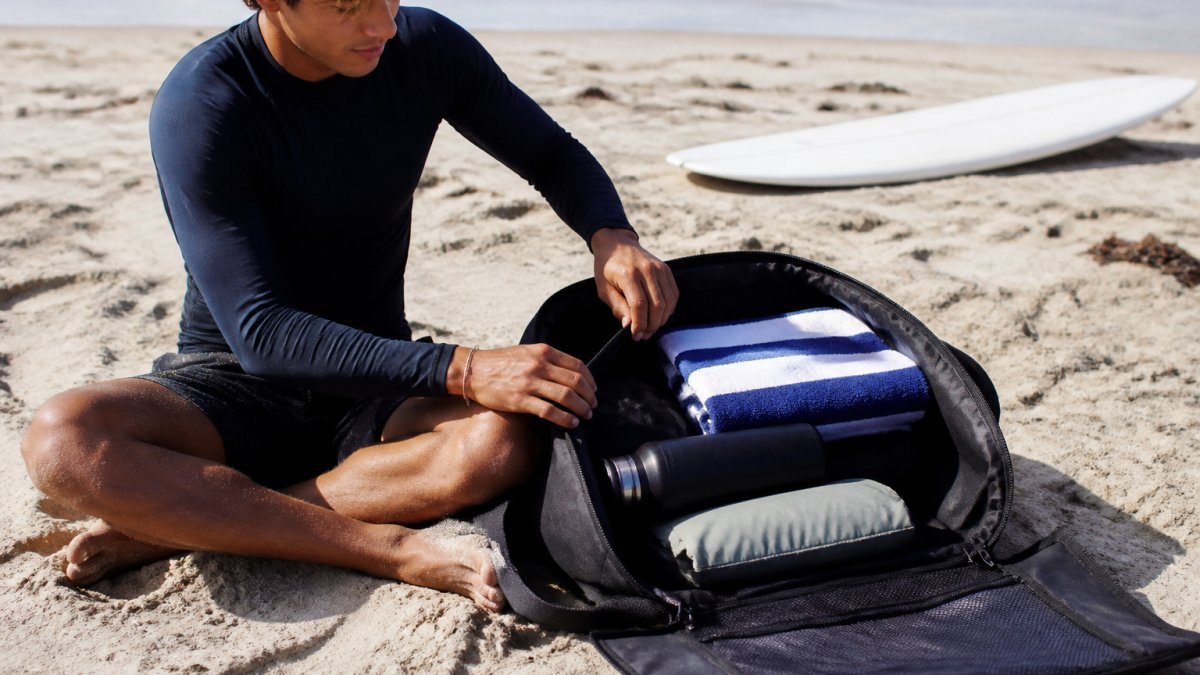
Most people pack a bag for the walk to the water. Surfers need one for the whole arc of the day: the paddle out, the long sit between sets, the dry-off, the drive home. That changes what you carry and how you carry it.
Bag size and shape: what actually fits a full surf day
A surf bag needs enough room for a towel, a change of clothes, water, food, sun protection, and a wet suit or rash guard on the way home. Look for a wide opening that lies flat. Shoulder straps help on long walks. A separate outer pocket for wet gear saves the rest of your kit.
The three-zone system: dry, damp, and soaked
Split your bag into three zones before you pack anything.
- Dry zone: towel, change of clothes, snacks, phone
- Damp zone: rash guard you might wear again, hat, sunglasses case
- Soaked zone: wetsuit, wet swimwear, anything dripping
This one habit prevents most of the mess a surf day creates. Pack the dry zone at the bottom or in a separate compartment, and keep the soaked zone in a waterproof bag on top.
Your Surf Day Packing List, Built in Layers
Think of your surf day packing list in three layers: what you wear, what you carry to the water, and what waits in the car or at the bag. Layering keeps your load light and your essentials close.
Here is the summary we build every session around:
| Layer | What Goes In | Where It Lives |
|---|---|---|
| On you | Swimwear, rash guard, sunscreen | Worn to the beach |
| To the water | Board, leash, fins, water, wax | Carried in hand or bag |
| At the bag | Towel, dry clothes, snacks, hat | Dry zone |
| Post-surf | Warm layer, dry shorts, sandals | Dry zone, packed last |
Pack the "at the bag" layer first. It is what you reach for when you come out of the water tired and cold.
What to Bring Surfing: The Core Gear You Cannot Leave Behind
The core of what to bring surfing is board, leash, fins, wax, and water, plus a rash guard or wetsuit for the conditions. Everything else supports those five items. Skip one and the session usually ends early.
But a full day of surfing needs more than the five-item core. Our guide to essential open-water swim gear expands on the items that complement your surf kit.
The full-day surf bag checklist, in packing order
Pack in this sequence. Each group sits on top of the last, so the items you reach for first are easiest to grab.
- Soaked zone (bottom or separate compartment): wet/dry bag, spare leash string, fin key, wax comb.
- Damp zone (middle): rash guard you may re-wear, hat, sunglasses case, small towel for feet.
- Dry zone (top): dry towel, change of clothes, warm layer, snacks, water, sunscreen, phone pouch, first-aid pouch.
- Car or bag-side kit: second water bottle, backup snack, sandals, board bag.
Must-haves versus comfort items
Separate the list into two columns before you pack. Must-haves are the items whose absence ends or ruins the session: board, leash, fins, wax, water, sun protection, towel, dry layer. Comfort items are the ones that make a long day pleasant: second snack, beach read, spare hat, extra water. If your bag is too heavy, cut comfort items first, never must-haves.
Board, leash, and fin essentials
Check your board before you leave the house, not on the sand. A missing fin screw or a frayed leash ruins a good swell. Carry a spare leash string and a small fin key in a zip pocket. If you use a board bag, strap it down so it does not slide around in the car.
Safety and emergency essentials
A full day on the water warrants a minimal safety kit that most beach-bag lists skip. Include a small first-aid pouch with antiseptic wipes, adhesive bandages, and blister pads; a whistle attached to your bag or leash; and a waterproof pouch for your phone so emergency contacts stay reachable. Know the local emergency number and have it saved before you paddle out.
Surfing Sun Protection That Survives the Water
Surfing sun protection is the part most packing lists undersell. You are exposed for hours, often with reflected light off the water, and regular lotion washes off fast. Pack sun protection you can reapply with wet hands.
Start with a water-resistant sunscreen and a face stick for the nose and cheeks. For a deeper look at sun protection for water sports, see our full guide. Our wide-brim sun hat is a lightweight option for long days outdoors.
Post-Surf Essentials: Warmth, Dry Clothes, and Recovery
Post-surf essentials are the items you will be most grateful for and most likely to forget. Coming out of cool water drops your body temperature fast, even on a warm day.
Pack these in the dry zone, on top:
New upgrade of beach towel softer more comfortable →
- A dry towel, ideally one that folds small
- A change of clothes, starting with quick-dry shorts
- A light warm layer for windy afternoons
- Sandals or flip-flops for the walk back
- Water and a snack for the drive home
Our soft terry cloth beach towel folds into its own mesh bag for easy packing.

Watch out: leaving a wet towel balled up in your bag overnight is how bags start to smell. Hang it to dry the moment you get home.
Keeping Wet Gear Separate and Sand Out of Everything Else
Wet gear management is where most surf bags fail. A wetsuit in the main compartment soaks everything it touches.
Sand is the other problem. A small towel or mat at the bag opening gives you a clean spot to stand on while you change.
Packing cubes help here too. One cube for dry clothes, one for toiletries, one for small gear. You will find things faster and keep sand out of the clean zone.
Packing for Changing Surf, Weather, and Tide Conditions
Conditions shift, and a bag packed for a sunny morning can leave you cold by afternoon. Build in one extra layer and one extra dry item beyond what the forecast suggests.
Most packing guides treat every beach day the same. A full day of surfing is not the same, and the gap worth claiming is a set of concrete adaptation rules for water temperature, wind, sun, tides, and session length.
Adapt to water temperature
Water temperature, not air temperature, decides your suit and your post-surf layers. A cold-water session demands a thicker wetsuit, a warm hat, and a dry fleece or hoodie in the dry zone. Warm water lets you downsize to a rash guard and thin neoprene, but a windproof shell still earns its place for the walk back. Pack the layer you would want if the wind picked up and you were still wet.
Adapt to wind and sun exposure
Wind strips heat faster than still air, so a windproof outer layer is worth more than an extra base layer on a breezy coast. For sun, plan reapplication around your session, not the clock: a water-resistant sunscreen and a face stick for nose and cheeks, SPF lip balm, and a hat for between sessions. Reflected light off the water means you burn faster than the forecast suggests, so pack more sun protection than you think you need.
Adapt to tides and session length
Tide matters as much as weather. A rising tide can shorten your walk back to the car, and a falling tide can lengthen it. Check the tide chart before you pack, then plan your water and snack supply around how long you will actually be out. For a long session, add a second water bottle and a backup snack; for a short one, cut the comfort items and keep the must-haves.
A quick adaptation matrix
| Condition | Add to the bag | Drop from the bag |
|---|---|---|
| Cold water | Thicker suit, warm hat, dry fleece | Extra rash guard |
| Warm water | Rash guard, thin neoprene, extra sunscreen | Heavy warm layer |
| Windy | Windproof shell, extra dry towel | Beach read |
| Strong sun | Face stick, lip balm, wide-brim hat | , |
| Long session | Second water bottle, backup snack | , |
If you are heading out for a longer stretch, treat it like a mini surf trip. Pack a beach read, a second water bottle, and a backup snack. Small additions make a full day feel easy instead of long.
Stock Your Surfing Beach Bag Before the Next South Bay Session
The best time to pack your surfing beach bag is the night before, not the morning of. Lay everything out flat, run the three-zone check, and load the dry zone last. You will sleep better and paddle out sooner.
A few habits separate a smooth session from a scramble:
- Keep a packed "base kit" in the bag between trips
- Restock sunscreen and water after every session
- Wash and dry the towel and wet bag before repacking
- Check the leash and fins before you leave the house
Our roots go back to 1960 in Manhattan Beach, and our approach is simple: gear that is easy to pack and ready for the sand. Shop our beach towels and sun hats to build your bag.
Frequently Asked Questions
What should I pack for a full day of surfing?
Build your surf day packing list in three groups: gear (board, leash, fins, wax, rash guard), protection (SPF 30 or higher sunscreen, SPF lip balm, a wide-brim hat, sunglasses), and comfort (two towels, a full change of clothes, 2 to 3 liters of water, snacks, and a wet/dry bag). Add a waterproof phone pouch and a small first-aid kit. Pack the dry items at the bottom of your surfing beach bag so wet gear goes on top at the end of the day.
What do surfers need after a surf session?
Post-surf essentials come down to warmth and dryness. Pack a towel you can wrap around yourself immediately, a full change of clothes, and a light layer for wind. A hat and a refillable water bottle make the walk back easier, and a wet/dry bag keeps your wetsuit or rash guard from soaking everything else in your surfing beach bag.
How do I keep wet surf gear separate from dry items?
Use one waterproof bag with a roll-top or zip closure for anything soaked, and keep it empty on the way out so it takes up almost no room. Pack dry clothes and towels in a separate compartment or packing cube. Never put a wet wetsuit in the same space as dry clothes, even briefly, because salt water wicks into fabric fast.
How much water should I bring for a day of surfing?
Plan on 2 to 3 liters per person for a full day in the sun, more on hot days or during long sessions. Surfing is harder work than it looks, and time in salt water plus sun exposure drains you faster than a normal beach day. Bring a refillable bottle and stash it in the shade or under a towel. If you are staying for several hours, add a second bottle or a hydration pack.
Packing for a full surf day comes down to three zones, one flat-opening bag, and a dry layer you can count on. South Bay Gear builds coastal gear for exactly that kind of day, from terry cloth towels that fold into their own mesh bag to UPF 35 wide-brim hats with moisture-wicking sweatbands. Get started with South Bay Gear and pack a bag that is ready before the swell is.

0 comments