Table of Contents
- Quick Comparison: Best Swim Gear for Open Water
- Open Water Swimming Safety Tips Before You Buy Anything
- The Benefits of Using a Swim Buoy (And Why It Tops the List)
- How to Choose Open Water Goggles That Actually Fit
- Thermal Protection: Wetsuits, Caps, Gloves and Booties
- Swimwear and Post-Swim Gear That Holds Up in Salt Water
- Gear Maintenance, Longevity and Budget-Friendly Kits
- A few habits extend gear life significantly:
- Frequently Asked Questions
Last Updated: September 23, 2026
Quick Comparison: Best Swim Gear for Open Water
The best swim gear for open water starts with a tow float; everything else supports it. The seven essentials: a safety buoy, well-fitted goggles, thermal protection, a visibility cap, anti-chafe protection, a dry bag, and a changing robe.
At South Bay Gear, we have roots dating back to 1960 in Manhattan Beach, capturing the authentic spirit of the South Bay area. Below: each essential with pricing, pros and cons, and the water conditions it suits.
| Essential | Typical Price | Best For | Priority |
|---|---|---|---|
| Tie-dye one piece swimsuit | $40.10 | Warm-water swims | Core |
| Sharky boys' trunks | $33.06 | Young swimmers, ages 8-15 | Core |
| Mid-length board shorts | $37.20 | Men, daily wear | Core |
| Custom bikini swimsuit | $38.72 | Training and beach days | Core |
| Beach Life racerback tank | $26.87 | Post-swim cover-up | Support |
| Wide brim sun hat | $67.50 | Sun exposure between swims | Support |
| Trucker or volleyball cap | $31.78-$40.72 | Everyday coastal wear | Support |
Open Water Swimming Safety Tips Before You Buy Anything
Open water swimming safety tips begin with one rule: never swim alone, and never swim without a visible float. A tow float marks your position for boats and other swimmers, and gives you something to rest on if you tire mid-crossing.

Cold water is the second risk. Water pulls heat from your body far faster than air, so a swim that feels fine for ten minutes can turn dangerous at twenty. Acclimation takes repeated short exposures, not one long one: start with brief dips in water you can stand up in.
Here is what most guides skip: check the current and wind direction before you enter, not after. A swim out is easy; the swim back against a turning tide is where people get into trouble. NOAA rip current safety guidance explains how currents behave near shorelines, and the same principles apply to open water crossings.
The Benefits of Using a Swim Buoy (And Why It Tops the List)
The benefits of using a swim buoy come down to three things: visibility, buoyancy, and confidence. A brightly colored tow float sits behind you on a short leash, so boaters see you before they see your head, and it holds small items like a phone in a waterproof bag, keys, or a hydration flask.
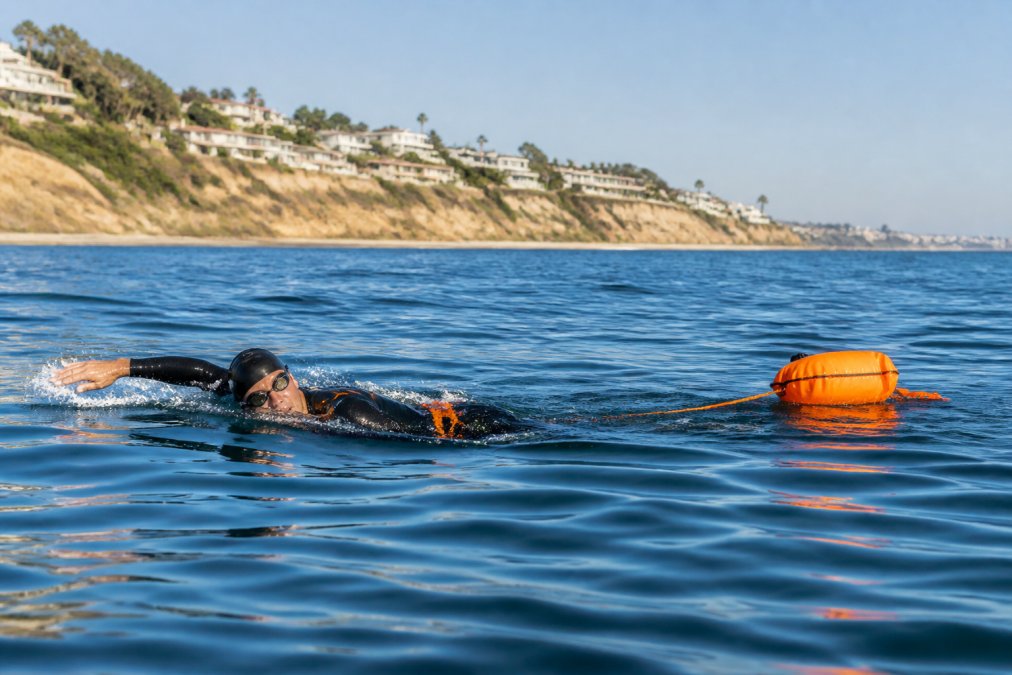
Buoyancy matters more than most new swimmers expect. A safety buoy will not keep an exhausted swimmer afloat indefinitely, but it gives you a stable platform to pause, breathe, and regroup without heading for shore, often the difference between a scare and an incident.
How to Choose Open Water Goggles That Actually Fit
How to choose open water goggles comes down to fit first, lens second, seal material third. A goggle that leaks is useless no matter how good the lens is.
Thermal Protection: Wetsuits, Caps, Gloves and Booties
Thermal protection is important for open water swimming.
| Water Temperature | Recommended Protection | Swim Duration |
|---|---|---|
| Above 78°F | Swimsuit only | Extended |
| 70-78°F | Swimsuit, optional thermal cap | Extended |
| 60-70°F | Wetsuit, thermal cap | Moderate |
| 50-60°F | Full wetsuit, gloves, booties | Short, supervised |
| Below 50°F | Full thermal kit, expert only | Very short |
Swimwear and Post-Swim Gear That Holds Up in Salt Water
Swimwear that survives salt water is built from fabric that resists chlorine and salt damage. Look for polyester and spandex blends, which hold their shape and resist fading better than nylon.
The South Bay Tie-Dye Floral Pattern Ladies One Piece Swimsuit ($40.10) uses an 86% polyester, 14% spandex blend with adjustable leg straps. For training days, the Tie Dye Custom Bikini Swimsuit ($38.72) is made from 85% polyester and 15% spandex with heat-sublimation printing that will not fade in water. Men get the IYKYK Men's Mid-Length Beach Board Shorts ($37.20), a 100% polyester pair with a mesh lining and an adjustable drawcord. For younger swimmers, the Big Boys' Sharky Swimming Trunks ($33.06) fit ages 8-15 in a smooth, close-fitting cut.

Post-swim, a dry bag protects your phone, keys, and dry clothes. For sun between swims, the Manhattan Beach Hometown Fair 2026 Wide Brim Sun Hat ($67.50) offers UPF 35 protection with a 2.5-inch brim and an adjustable bungee that holds in wind. The Beach Life Racerback Tank ($26.87) works as a light cover-up over a wet suit.
Gear Maintenance, Longevity and Budget-Friendly Kits
Gear maintenance is where most swimmers lose money. Rinse everything in fresh water after every saltwater session: salt crystals grind against fabric fibers, break down elasticity, and corrode goggle seals and zippers faster than anything else.
A few habits extend gear life significantly:
- Wash swimwear in cold water and skip the dryer entirely
Budget-friendly kits are easier than they look. Build in stages: start with a tow float and well-fitted goggles, then add thermal protection as the water cools. A full starting kit can be budget-friendly.
The environmental angle matters too. Cheaper gear that fails after one season ends up in a landfill, so paying slightly more for a suit that holds its shape for years is the lower-waste choice. EPA guidance on reducing waste covers the broader principles, and they apply directly to swim gear.
For sun protection between swims, CDC sun safety recommendations recommends shade and covering up during peak hours, which is exactly what a wide brim hat and a light cover-up are for.
Frequently Asked Questions
What gear do I need for open water swimming?
At minimum you need a swimsuit. Start with the essentials.
Do I need a wetsuit for open water swimming?
It depends on water temperature and how long you plan to swim.
How do I stay safe while swimming in open water?
Never swim alone. Use a tow float or safety buoy so you are visible to boats, paddleboards and other water users. Check water temperature and currents before you get in, and practice cold water acclimation by entering slowly. Carry a whistle attached to your buoy, and set a sighting marker on shore so you can check your position. Tell someone where you are swimming and when you expect to be back.
Are swim buoys necessary for open water swimming?
They are not legally required in most places, but they are one of the most valuable pieces of open water swim gear you can own. A swim buoy makes you visible to boats, gives you something to float on if you need a rest, and doubles as a dry bag for keys or a phone on some models. The benefits of using a swim buoy go beyond safety: they build confidence for newer swimmers and make sighting easier in choppy water.
How should I choose the right open water goggles?
Look for a wide, single-lens design that gives you peripheral vision for sighting. Choose tinted or polarized lenses for bright sunny days and clear lenses for overcast or early morning swims. Anti-fog coating matters because open water swimmers rarely stop to defog. Test the seal by pressing the goggles to your face without the strap, if they stay put, the fit is right. Replace goggles once the anti-fog coating wears off or the seal loosens.
Open water swimming rewards preparation, and the right gear makes the difference between a swim you repeat and one you never try again. South Bay Gear has outfitted coastal swimmers since 1960 with classic beachwear built for salt, sun, and sand. Our swimwear uses polyester and spandex blends that hold their shape, our hats offer UPF 35 protection with wind-secure fits, and select items ship free. Get started with South Bay Gear and gear up for your next open water swim.
0 comments