Table of Contents
- Why Swimwear Prices Have Climbed, and What You Actually Pay For
- Is Expensive Swimwear Worth the Price? The Cost-Per-Wear Math
- Signs of Poor Quality Swimwear to Check Before You Buy
- How Long Should a Swimsuit Last?
- How to Care for High-Quality Swimwear So It Earns Its Price
- Repair or Replace? What Most Buyers Get Wrong
- Conclusion: Who Should Pay More, and Who Shouldn't
- Frequently Asked Questions
Last Updated: September 27, 2026
Why Swimwear Prices Have Climbed, and What You Actually Pay For
Swimwear prices have climbed because the cost of making a suit that survives chlorine, salt, and sunscreen has climbed with it. Fabric composition is the first thing you pay for. A suit built from a nylon and spandex blend with high elasticity retention costs more to produce than a thin polyester shell that pills after a season.
Construction is the second. Double-lined panels, seamless construction, and high stitch density take time on a machine, and that time shows up in the price tag.
Hardware durability matters too. Cheap zippers, clasps, and sliders corrode in saltwater and fail long before the fabric does.
At South Bay Gear, we've watched the same pattern play out for decades along the coast: the expensive suit and the cheaper suit often look identical on the rack. They stop looking identical after ten wears.
Is Expensive Swimwear Worth the Price? The Cost-Per-Wear Math
Expensive swimwear is worth the price when the cost-per-wear math works in its favor. A $150 suit worn 150 times costs $1.00 per wear. A $25 suit worn 15 times costs $1.67 per wear. The cheaper suit costs more every time you put it on.
That single calculation explains why price-to-value ratio matters more than the sticker price. But the math only holds if you understand why an expensive suit survives more wears, and that comes down to fabric chemistry, not marketing.
The Fabric Technology Behind the Price Gap
Most budget suits are built from a polyester-spandex or nylon-spandex blend with a low spandex percentage (often 10-15%) and no chlorine-resistant treatment. That works fine for occasional wear. It fails fast under repeated exposure to pool chemicals or saltwater.
Higher-priced suits typically use one or more of the following:
- Higher spandex content (18-22%). More elastane means better shape recovery after stretching. The trade-off is that spandex is the first fiber to degrade in chlorine, so a high-spandex suit needs a chlorine-resistant finish to last.
- PBT (polybutylene terephthalate) blends. PBT resists chlorine degradation better than standard spandex and is common in competitive and frequent-swim suits. It costs more per yard, which shows up in the price tag.
- Recycled nylon (e.g., ECONYL-style regenerated nylon). Made from reclaimed fishing nets and carpet fiber, it performs like virgin nylon but carries a higher production cost. It is a legitimate reason for a higher price, not a greenwashing label.
- UPF-rated knits. A UPF 50+ rating means the fabric blocks roughly 98% of UV radiation. Budget suits rarely test for this because testing adds cost.
- Compression blends. Higher-denier yarns with tighter knit structures provide muscle support and hold shape longer. They feel firmer on the body and cost more to produce.
A common pattern is that a $25 suit uses a 90/10 polyester-spandex knit with no chlorine treatment, while a $150 suit uses a chlorine-resistant PBT blend or a high-spandex nylon with a UPF finish. That difference is what the extra money buys, and it is what makes the cost-per-wear math work.
How to Run the Numbers Yourself
Use this formula before you buy:
Cost per wear = Purchase price ÷ Expected number of wears
| Suit | Price | Expected Wears | Cost Per Wear |
|---|---|---|---|
| Budget suit | $25 | 15 | $1.67 |
| Mid-range suit | $75 | 60 | $1.25 |
| Investment piece | $150 | 150 | $1.00 |
The math only holds if you care for the garment properly. Garment longevity depends on both construction and maintenance, which is why the care section below matters as much as the price tag.
A Quick Reality Check on the Numbers
Expected-wear figures are estimates, not guarantees. A suit worn twice a week in a chlorinated pool will not hit 150 wears regardless of price. A suit worn a few times a month in the ocean can exceed it. Adjust the expected-wear number to your actual swim frequency before you decide the math favors one price point over another.
Signs of Poor Quality Swimwear to Check Before You Buy
The clearest sign of poor quality swimwear is thin, single-layer fabric that turns transparent when stretched. Hold the suit up to light and pull gently. If you can see your hand through it, it will go see-through when wet.
Other warning signs:
- Weak stitch density. Sparse stitching along seams means the suit will split under tension.
- Cheap hardware. Plastic sliders that flex easily will crack within a season.
- No lining. Unlined suits stretch out faster and offer less opacity.
- Fabric that feels slick and thin. This usually signals a high synthetic fiber content with poor elasticity retention.
Pilling is another giveaway. Rub the fabric against itself. If small balls form immediately, the suit will look worn within weeks.
Tie Dye Custom Bikini Swimsuit →
How Long Should a Swimsuit Last?
A well-made swimsuit should last one to two years with regular use, and longer with careful maintenance. A cheap suit used the same way typically lasts a single season.
The difference comes down to elasticity retention and fabric composition. Suits with higher spandex content and chlorine resistance hold their shape through repeated wash and swim cycles.
Chlorine is the biggest variable. A suit worn twice a week in a chlorinated pool will degrade faster than one worn in the ocean, regardless of price. Rinsing immediately after every swim extends lifespan more than any other habit.
If you swim daily, expect to replace any suit within a year. If you swim a few times a month, a quality suit can easily stretch to three seasons.
How to Care for High-Quality Swimwear So It Earns Its Price
Caring for high-quality swimwear comes down to three habits: rinse immediately, wash cold, and dry in shade.
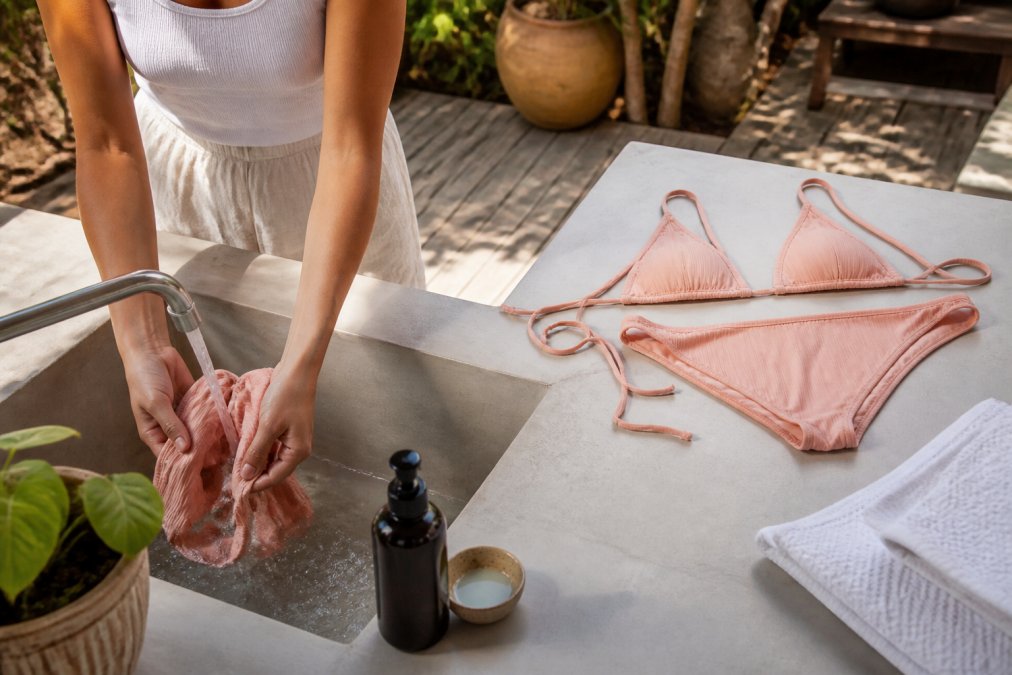
For printed suits, the FTC care labeling requirements give you the baseline for what a manufacturer must disclose. Follow the label, but treat cold water and shade drying as non-negotiable regardless of what it says.
Repair or Replace? What Most Buyers Get Wrong
Repair beats replacement more often than people assume. A broken slider, a loose strap, or a small seam split can usually be fixed for a few dollars. This is the angle most swimwear guides skip entirely: the question is not just whether an expensive suit lasts longer, but whether it can be kept alive when something fails.
The Failure-Mode Framework
Not all failures are equal. Sort them into three buckets before you decide.
Repairable failures (fix it):
- Hardware failure. Sliders, clasps, rings, and adjusters are the most common failure point on any suit, expensive or cheap. A corroded or cracked slider can be swapped in minutes with a replacement part. This is the single cheapest fix in swimwear.
- Strap and seam failure. A popped seam or a stretched-out strap can be re-stitched by a tailor or a home sewer with a stretch stitch. Cost is typically a few dollars to a local alteration shop.
- Lining separation. If the outer shell is intact but the lining has detached at a seam, it can be re-tacked.
Borderline failures (judge case by case):
- Localized pilling. If pilling is confined to one area (e.g., where a strap rubs), it may be cosmetic. If it is spreading across the whole garment, the fiber structure is failing.
- Fading in one panel. A single faded panel may be a dye issue, not a fiber issue. If opacity is intact, the suit is still wearable.
Not worth repairing (replace it):
- Lost elasticity retention across the whole garment. If the suit sags when you hold it up, the spandex has degraded. No repair brings elastane back.
- Widespread thinning or transparency. If the fabric has gone see-through when stretched, the knit structure has failed.
- Fading that has compromised opacity. A faded suit that is still opaque is fine; a faded suit that is now sheer is not.
Why Repairability Is the Real Sustainability Argument
Most articles frame expensive swimwear as a sustainability choice because it lasts longer. That is only half the story. The stronger argument is that a well-built suit can be repaired, which extends its life past the point where a cheap suit would be discarded.
Conclusion: Who Should Pay More, and Who Shouldn't
Pay more if you swim frequently, care about fit consistency, and want a suit that holds its shape past one season. The cost-per-wear math favors the investment piece for anyone swimming weekly.
Frequently Asked Questions
How much does an average bathing suit cost?
Most one-piece swimsuits in the U.S. sell between $30 and $90, while designer or technical suits run $150 to $400 or more. The gap usually comes down to fabric quality, construction, and how many seasons the suit survives. A well-made swimsuit at a mid-range price can outlast two cheap ones, so the sticker price alone rarely tells the full story. Compare cost per wear, not just checkout price.
Do expensive swimsuits last longer than cheap ones?
Often, yes, but only when the price reflects real construction. Look for tight stitch density, four-way stretch fabric, and double-lined panels. A suit with those features can hold its shape through many wears, while a fast-fashion suit may lose elasticity quickly. Expensive swimwear without those details is just a label, so check the build before you pay more.
What materials make swimwear more durable?
A blend of polyester or recycled polyester with spandex (often 80/20 or 85/15) resists chlorine and UV damage better than nylon, which breaks down faster in pools. Higher spandex content improves elasticity retention, and a double-lined front adds opacity and shape support.
How long should a swimsuit last?
A quality swimsuit worn once or twice a week typically lasts one to two years with proper care. Cheap suits used the same way often fade, pill, or stretch out within a single season. Rinsing in cold water after every use, avoiding hot dryers, and rotating between two suits are the biggest factors that push a swimsuit toward the upper end of that range.
0 comments