Table of Contents
- Quick Comparison: Durable Swimwear for Active Water
- What Makes Swimwear Durable Enough for Active Water
- Stay-Put Fit: Swimsuits That Stay in Place During High-Impact Water Sports
- Top Picks: South Bay Gear Swimwear Built for Active Water
- Cons:
- Pros:
- How to Wash Active Swimwear to Extend Its Life
- Repair, Longevity, and the Environmental Cost of Microplastics
- Conclusion
- Frequently Asked Questions
Last Updated: September 11, 2026
Quick Comparison: Durable Swimwear for Active Water
The best durable swimwear for active water comes down to fabric composition, seam construction, and fit engineering, not brand hype.
Here is the short version before we get into the technical detail:
| Pick | Fabric | Best For | Price | Standout Detail |
|---|---|---|---|---|
| Tie-Dye Floral One Piece | 86% polyester, 14% spandex | Lap swimming, aquatic exercise | $40.10 | Adjustable leg straps, full coverage |
| IYKYK Men's Board Shorts | 100% polyester | Surfing, beach volleyball | $37.20 | Mesh lining, drawcord waist |
| South Bay Tie-Dye Bikini | 85% polyester, 15% spandex | Swim lessons, training | $38.72 | Heat-sublimated print that resists fading |
| Beach Life Bikini | 85% polyester, 15% spandex | Pool and beach days | $38.72 | Four-way stretch, sizes S through 5XL |
Swimwear that lasts three seasons versus swimwear that sags by August comes down to two things: fabric recovery after stretching, and seam finishing.

What Makes Swimwear Durable Enough for Active Water
Durable swimwear is fabric engineered to resist chlorine degradation, UV damage, and mechanical stress while recovering its shape after repeated stretching. Three factors decide whether a suit survives a season: fiber blend, stretch recovery, and seam construction.
Most cheap suits fail at the fiber level. Chlorine attacks spandex faster than any other fiber, which is why competitive swimwear leans on polyester-dominant blends.
Fabric Technology: Recycled Polyamide, Four-Way Stretch, and Elastic Recovery
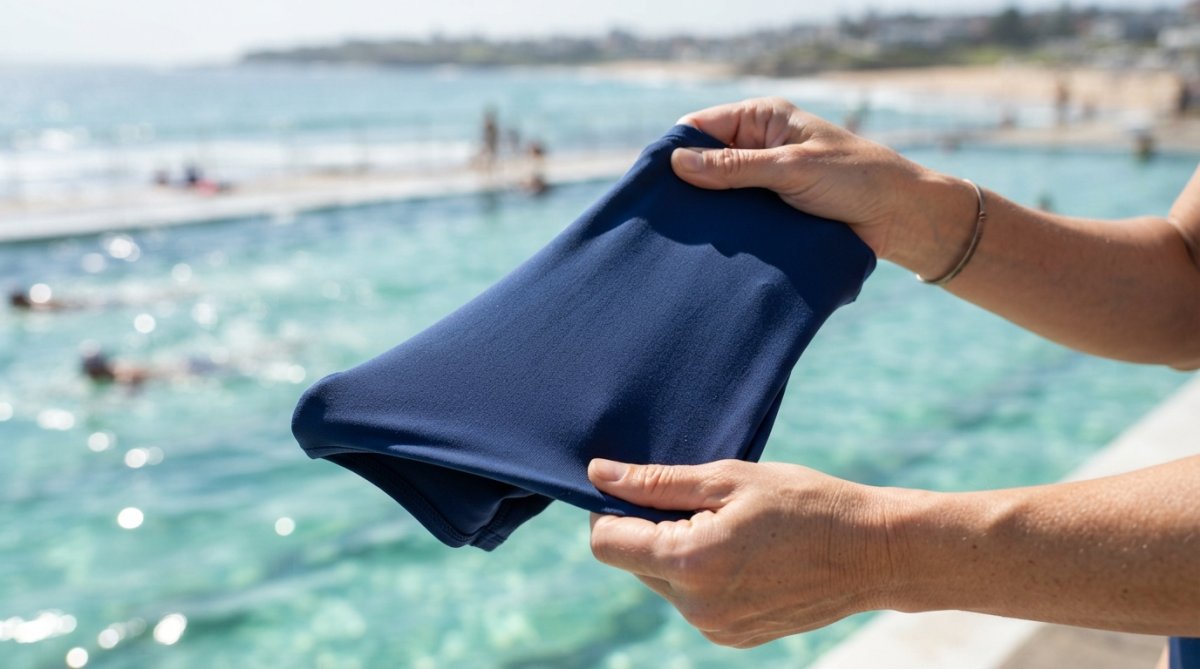
Recycled polyamide and polyester blends dominate durable swimwear because they resist abrasion and hold color longer than nylon. Four-way stretch moves in every direction, which matters when paddling or pushing off a pool wall.
Elastic recovery is the metric most shoppers ignore: a suit with poor recovery stretches out permanently, so straps slide and seats sag. Look for spandex content between 14% and 20%.
Chlorine Resistant Swimwear vs. Saltwater-Safe Construction
Chlorine resistant swimwear uses tightly woven polyester blends that shrug off chemical degradation, while saltwater-safe construction resists abrasion from sand and sun. If you split time between a lap pool and the ocean, prioritize chlorine resistance.
Saltwater itself is gentler on fabric than pool chemicals, but the sun and sand are not. UV exposure breaks down elastic fibers over time, and sand acts like sandpaper on seams. Rinsing immediately after every swim, whether in a pool or the ocean, is the single highest-impact habit for extending a suit's life. The CDC guidance on healthy swimming and pool chemistry explains why chlorine levels vary so much between facilities, which directly affects how fast your suit wears out.
Stay-Put Fit: Swimsuits That Stay in Place During High-Impact Water Sports
Swimsuits that stay in place during high-impact water sports rely on compression fit, flatlock seams, and hardware-free design.
The most common mistake is sizing down for a tighter fit: that stretches the fabric past its recovery limit before you get in the water. Buy your actual size and let the construction do the work.
Compression Fit, Flatlock Seams, and Hardware-Free Design
Compression fit keeps fabric close without cutting off circulation, reducing drag and preventing shifting. Flatlock seams lie flat so they do not chafe, and hardware-free design eliminates zippers, clasps, and rings that can snag, rust, or pop open mid-swim.
- Adjustable straps and leg openings let you dial in tension without sizing up or down
- Wide elastic bands distribute pressure instead of digging in
- High necklines and full-coverage cuts reduce the surface area that can shift
Why Body Shape Changes What "Stay-Put" Actually Means
Where a suit migrates during a dolphin kick, duck dive, or beach sprint depends on your torso-to-hip ratio, shoulder width, and bust-to-band differential, not the size tag.
A few patterns worth knowing before you buy:
- Long torso relative to hip width: Fixed-cut one-pieces pull down at the shoulder and ride up at the leg opening. Adjustable leg straps and a higher neckline compensate better than a larger size, which just adds slack elsewhere.
- Short torso relative to hip width: One-pieces bunch at the waist and the seat sags after a few laps. Look for a higher spandex percentage (closer to 18-20%) so the fabric snaps back instead of folding.
- Broad shoulders with a narrow ribcage: Straps slide off during overhead strokes. Cross-back or racerback construction anchors the straps to the spine rather than the shoulder edge.
- Full bust with a small band: A single compression panel cannot hold both zones. Look for a built-in shelf bra or a separate underband so the band does the anchoring and the cup does the covering.
- Straight hip-to-waist ratio: Bikini bottoms with side ties or adjustable leg straps let you tension the hip independently of the waist, which fixed-cut bottoms cannot do.
None of this is about flattery. It is about where the fabric is under load. A suit that fits your proportions experiences less stress at the seams, which is why it lasts longer.
Adjustability Features That Actually Do Something
The adjustable features that actually change fit under load:
- Adjustable leg straps or side ties: let you tension the hip opening independently of the waist, which is the single most useful adjustment for high-kick movement.
- Cross-back or convertible straps: redistribute tension across the upper back instead of the shoulder edge, which is where straps slip during freestyle and butterfly.
- Drawcord waists on board shorts: lock the waistband to the hip bone so the short does not rotate during a pop-up or a beach sprint.
- Wide, flat elastic bands: spread pressure over a larger area so the band does not roll or dig in when wet.
Features that sound adjustable but rarely help: decorative ties that do not tension anything, removable cups that shift inside a fixed pocket, and hook-and-loop closures that clog with sand and stop gripping after a few sessions.
Top Picks: South Bay Gear Swimwear Built for Active Water
South Bay Gear has offered coastal apparel from Manhattan Beach since 1960, and the current swim line reflects that heritage: simple cuts, durable fabrics, and prints that hold their color.
South Bay Tie-Dye Floral Pattern Ladies One Piece Swimsuit
The South Bay Tie-Dye Floral Pattern Ladies One Piece Swimsuit at $40.10 features an 86% polyester, 14% spandex blend and adjustable leg straps that tighten coverage for lap swimming or loosen for beach lounging.
The adjustable leg design allows for a customizable fit. Sizes run S through 2XL.
Pros:
- Adjustable leg straps suit multiple body types
- Full coverage for aquatic exercise and lap swimming
Cons:
IYKYK Men's Mid-Length Beach Board Shorts
For men, the IYKYK Men's Mid-Length Beach Board Shorts at $37.20 feature a 100% polyester shell, mesh lining, and an elastic waistband with drawcord.
The relaxed fit is designed for comfort.
Pros:
- Two front pockets for keys or wax
- Sizes XS through 5XL
Cons:
- Relaxed fit, not compression
The rest of the line follows the same formula. The Tie Dye Custom Bikini Swimsuit at $38.72 and the Beach Life Custom Bikini Swimsuit at the same price use 85% polyester and 15% spandex with all-over printing. Sizes run S through 5XL, and several styles ship free.


How to Wash Active Swimwear to Extend Its Life
The right way to wash active swimwear is a cold rinse immediately after every use, then a gentle hand wash with non-chlorine detergent and air drying in the shade. Skip the dryer: heat destroys elastic recovery.
Here is the routine that actually works:
- Rinse in cold water within 30 minutes of leaving the water
- Hand wash with a mild, non-chlorine detergent
- Never wring or twist the fabric; press water out gently
- Lay flat or hang to dry away from direct sun
- Never tumble dry, iron directly, or bleach
- Rotate between two suits so each one fully recovers between wears
Washing to Reduce Microplastic Shedding
Every wash of synthetic swimwear sheds microplastic fibers into waterways, and the NOAA research on microplastics in marine environments documents how these particles accumulate in ocean food chains. The goal is not to stop washing, it is to shed less per wash and wash less often.
What actually reduces shedding:
- Wash less frequently. A post-swim cold rinse removes chlorine and salt without agitation. Save the full wash for every third or fourth wear unless the suit is visibly soiled.
- Front-loading machines shed less than top-loaders. The central agitator in a top-loader is the single biggest driver of fiber loss. If you must machine wash, use a front-loader on a gentle cycle.
- Use a mesh wash bag or a fiber-catching laundry bag. These trap loose fibers before they reach the drain. A fine-mesh bag designed for synthetic activewear is the practical version of this.
- Skip the spin cycle. High-speed spinning is agitation by another name. Press water out by hand instead.
- Cold water only. Heat weakens fibers and makes them more likely to break off during the wash.
A common pattern among frequent swimmers is to keep two suits in rotation and rinse each one after every use, which cuts the number of full wash cycles roughly in half over a season.
Repair Before You Replace
Repair is the most overlooked longevity tool. A popped seam or stretched strap does not mean the suit is finished. Most common failures are fixable at home or by a tailor who handles swimwear, and each repair adds a full season to a suit that would otherwise get tossed. waterproof bug repellent.
Elastic degradation (straps and waistbands that have gone slack): The spandex has lost recovery, not the fabric. Replacing the elastic is the fix, a tailor can open the casing, thread new 3/8-inch swimwear elastic, and close it. This is usually cheaper than a new suit and restores the original tension.
Popped or frayed seams: Flatlock seams on swimwear are best repaired with a stretch stitch on a sewing machine, or by hand with a backstitch using polyester thread. Do not use cotton thread, it will rot in chlorinated water. A tailor who handles activewear can do this in minutes.
Zipper failure on board shorts or rash guards: Salt and sand are the usual culprits. Rinse the zipper track with fresh water, work a small amount of silicone zipper lubricant into the teeth, and cycle the zipper a few times. If the slider has separated from the track, a tailor can replace the slider without replacing the zipper.
Pilling or snags on the seat or inner thigh: Trim the pill with small scissors rather than pulling it, which pulls more fibers loose. A fabric shaver on a low setting works on polyester blends but should be tested on an inside hem first.
Faded panels from chlorine or sun: This one is not repairable. Once the dye has gone, it has gone. This is the failure mode that justifies replacement, and it is also the one most preventable through the rinse-and-shade-dry routine above.
When to Retire a Suit
Not every suit is worth saving. Retire it when the fabric itself has thinned to the point of transparency, when the print has faded across more than a small panel, or when the elastic has been replaced once and has gone slack again. Those are signs the base fabric has reached the end of its service life, and further repairs will not hold.
Repair, Longevity, and the Environmental Cost of Microplastics
Every wash of synthetic swimwear sheds microplastic fibers into waterways, and the NOAA research on microplastics in marine environments documents how these particles accumulate in ocean food chains. That does not mean you should stop swimming. It means you should wash less often, wash cold, and keep each suit in service longer.
Conclusion
The best durable swimwear for active water is the suit you actually maintain, not the one with the highest price tag. Fabric blend, seam construction, and a cold-rinse habit outlast any marketing claim.
South Bay Gear has offered apparel to the South Bay area since 1960, and the current line reflects that: simple cuts and polyester-dominant fabrics. The Tie-Dye Floral One Piece at $40.10 is suitable for lap swimming, the IYKYK board shorts at $37.20 are designed for surf, and the custom bikini range starts at $32.88 with free shipping on select styles.
Get started with South Bay Gear and put a suit through a real season, not just a photoshoot.
Frequently Asked Questions
Which brand of swimsuit is the most durable?
Durability depends on fabric and construction, not just brand name. Look for swimwear made from a polyester-spandex blend with at least 80% polyester, four-way stretch, and flatlock seams. South Bay Gear's swimwear uses 85% polyester and 15% spandex, which resists chlorine and saltwater breakdown better than lower-spandex alternatives. The heat sublimation printing also will not fade in water, so the pattern stays intact after repeated exposure to pools and ocean waves.
What are the best swimsuits that stay in place during high-impact water sports?
Swimsuits that stay in place typically have a compression fit, adjustable straps or leg openings, and hardware-free construction. South Bay Gear's one-piece swimsuit features adjustable leg straps and a medium-stretch polyester-spandex blend that wraps and shapes without riding up. For surfing or swim training, choose a suit with full coverage and flatlock seams that lie flat against the skin. Avoid suits with loose ties or metal clasps that can shift or snag during movement.
What fabric features make swimwear more durable in chlorine and salt water?
Chlorine resistant swimwear relies on a high polyester content, usually 80% or more, because polyester resists chemical breakdown better than nylon. Spandex adds stretch but degrades faster in chlorine, so a 15% spandex blend balances fit and longevity. Saltwater-safe fabrics also benefit from hydrophobic treatments that repel water and quick-dry properties that reduce prolonged moisture exposure. Rinsing your suit in cold water after every swim removes chlorine and salt before they can weaken the fibers.
How should I care for my active swimwear to make it last longer?
Rinse your swimwear in cold water immediately after each use to remove chlorine, salt, and sunscreen. Machine wash cold on a gentle cycle with non-chlorine detergent, or hand wash if the suit has delicate straps. Do not tumble dry; lay flat in the shade instead. Avoiding hot tubs and rough surfaces also prevents abrasion and extends the life of your suit.
Can I repair swimwear to make it last longer instead of replacing it?
Yes, small repairs can extend the life of durable swimwear. Use a needle and polyester thread to fix loose seams or hems, and apply a fabric patch designed for swimwear to cover small holes or thin spots. For stretched elastic, a tailor can replace the elastic band in some styles. Repairing instead of replacing also reduces the environmental impact of microplastics shedding from discarded synthetic fabrics. Proper care and timely repairs can add a full season or more to your suit's usable life.
0 comments